- Games
The Guide for Marisa of Liartop Mountain

Preface
Welcome to the guide for Marisa of Liartop Mountain.
In Marisa of Liartop Mountain, Reimu will go on an adventure to a mysterious world. But as long as you’re not a reckless adventurer (or one as lucky as Reimu), I should let you know all about the road ahead—and about the hidden treasures—before you embark on this dangerous journey.
If you’re reading this guide at all, that probably means you’re not reckless, and you’re not the type to trust in your own luck too much—which means you have the makings of a successful adventurer.
That’s it for the preface. Let’s get down to business.
What Kind of Game Is This?
Marisa of Liartop Mountain is a role-playing game, or RPG. It may look more like a visual novel, but it’s an RPG, so it’s important to gain experience points, strengthen your equipment, and level up your character to make her stronger. A powerful boss enemy waits for you at the very end, and once you defeat them, your journey will be complete!
The question now is… how to do all those things.
How to Overcome Difficulties (and Gain Experience Points)
In order to take on difficult challenges in Marisa of Liartop Mountain (such as making fifty thousand amulets in a single night), you’ll need to roll dice to determine how well you do.
Combat works the same way. For example, if you want to attack an enemy in front of you, you have to roll the dice to see whether or not you hit them, and how hard.
Let’s take a look at the game screen.
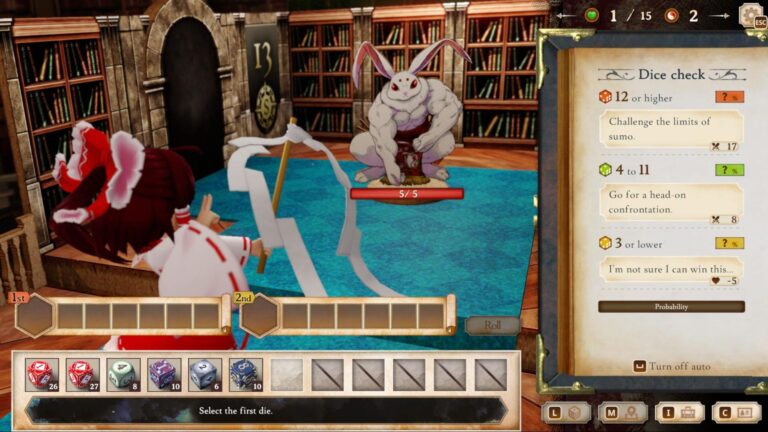
In order for Reimu’s attack to hit this strange-looking rabbit, you’ll need to roll 2 dice that add up to 4 or higher. (And if you get 12 or higher, her attack will be even stronger.)
Let’s go with these two dice. These are called “My Dice.” (They kind of look like Reimu, don’t they?)
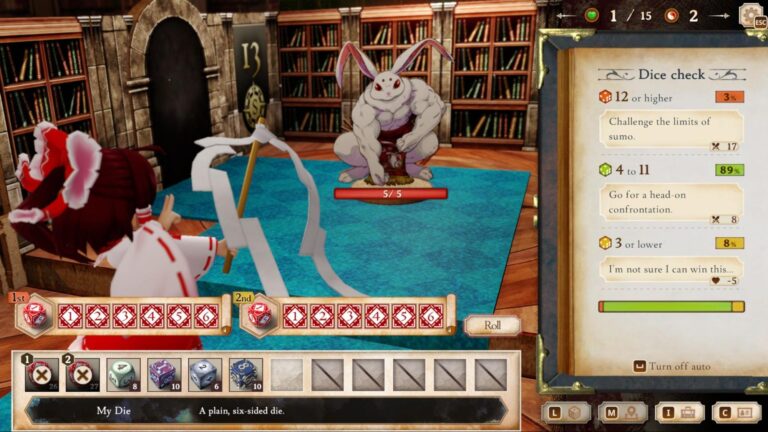
It seems like Reimu’s attack will almost certainly hit… but a sharp-eyed adventurer might want to stop and think for a moment.
In this game, when you choose the dice you want to roll, the game itself will calculate how likely each result will be. Let’s try picking a different die.
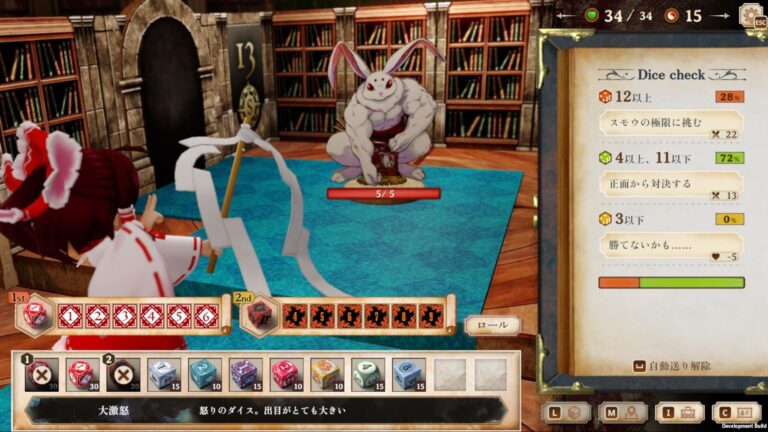
Here, we replaced one My Die with a Fury die. A Fury die has higher numbers on its faces than a My Die does. Now there’s no chance of rolling less than a 3 and failing. There’s also a much higher chance that Reimu’s attack goes really well (with a 12 or higher).
Before you press the Roll button, try picking different combinations of dice to see what your chances with them are.
Failure Doesn’t Always Mean Failure
That’s an annoying section title, huh? But it’s true—at least in Marisa of Liartop Mountain. In this game, even if you don’t get the dice roll you want, you can always decide not to accept the result.
Let’s take a look at another screenshot.
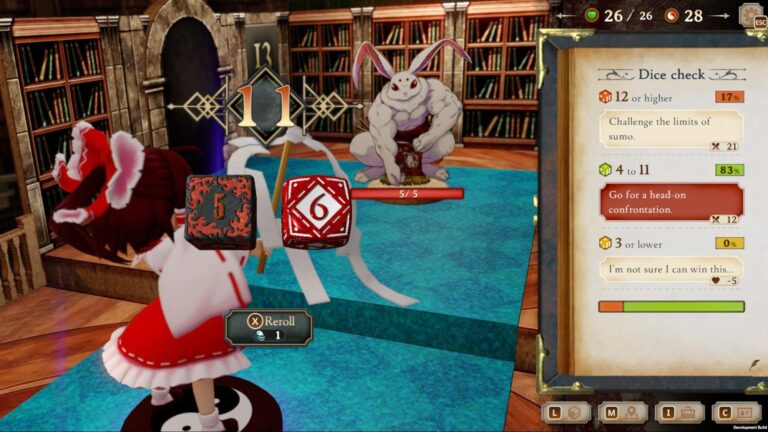
Reimu is attacking the strange rabbit and wants to get that really good result. Unfortunately, though, her dice only add up to 11. She needs 12 or higher to get that result, but she ended up getting something she didn’t wanted instead. You might think this whole thing is purely a game of chance!
But wait just a moment. See that “Reroll” button below the two dice? You’re allowed to reroll the dice if you don’t like what you got. I guess Reimu has never really played by the rules anyway.
Let’s try actually pressing the Reroll button.
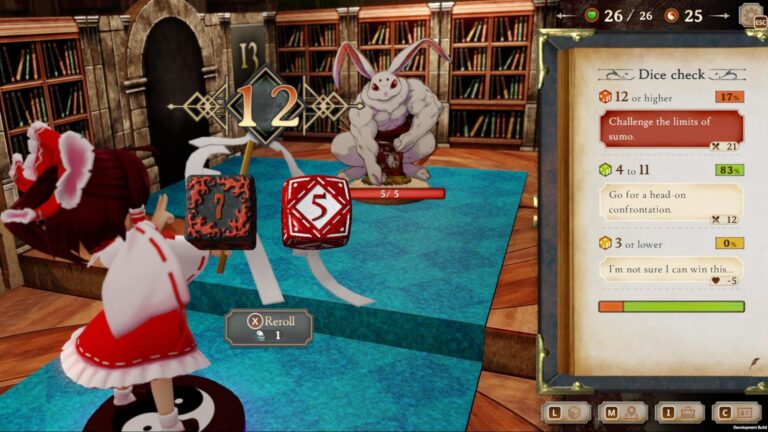
This time, we rolled 12 or higher just fine. A great success, just like we wanted.
Still, even Reimu can’t reroll her dice as many times as you want. Turn your attention to the numbers in the upper-right corner of the screen.
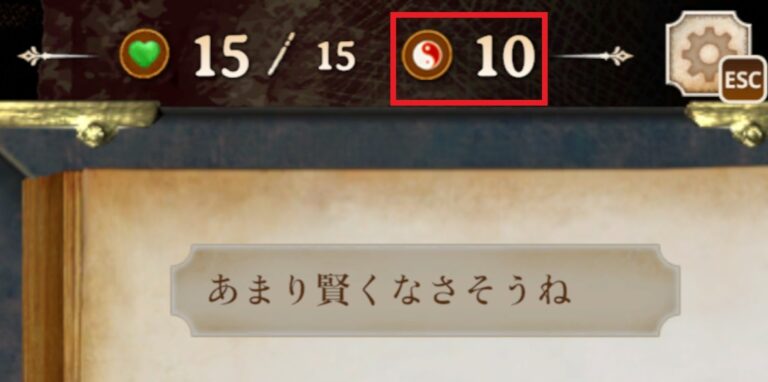
This is a stat called CP, or Cheat Points, which represents Reimu’s ability to fly in the sky. Whenever you press the Reroll button, you spend 1 CP.
An astute adventurer will have noticed that the previous image has 5 less CP than the one before that. This means the player had to reroll the dice 5 times to get that great success. Ah, it reminds me of the sunk cost fallacy. (Have you heard of the sunk cost fallacy? It’s something every adventurer should know about. I recommend looking it up.)
Master the Dice!
Marisa of Liartop Mountain may be an RPG, but there are no weapons or armor like in other ones. It’s Reimu, after all. Her body is already a deadly weapon.
Still, she’ll need a bit more strength in order to progress through her adventure. This game contains a wide variety of dice that will give her the strength she needs. I can’t show you all of them—someone would get mad at me for that—but I can show you a few of the interesting ones.
My Die
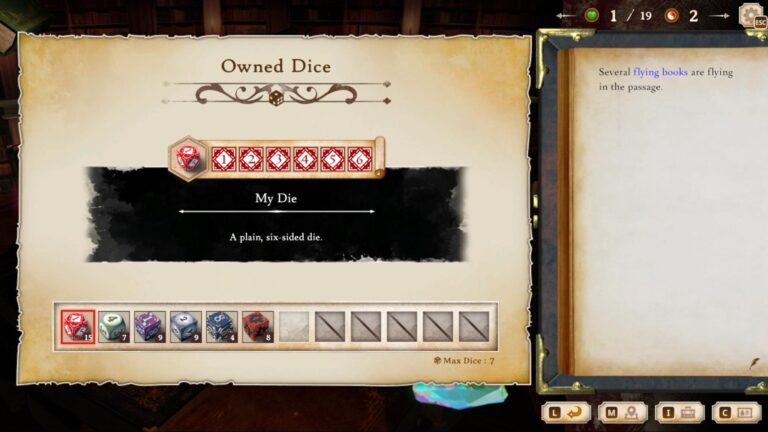
A plain, six-sided die.
1/2/3/4/5/6
Uses: 30
You get these dice from the very beginning, but they have a lot of different uses. You’ll want to pay attention to that use count of 30. Whenever you roll a die, it loses 1 use, and when it gets to 0 uses, it breaks. You’ll get a whole lot of dice during your adventure, but having one that will last a long time is an attractive prospect.
Skepticism
A die filled with a feeling of something unconvincing. Only has odd numbers on it.
1/1/3/3/5/5
Uses: 15
The most important trait of this die is that it only rolls odd numbers. Sometimes you may need to roll an odd number (or an even number) during your adventure—and when you do, you can pull out a die like this.
Fairness
A die with only even numbers on it. Even-handed, you could say.
2/2/4/4/6/6
Uses:15
If Skepticism was the odd-numbered die, this one is the even-numbered die. One thing you should keep in mind is that when you roll two dice, an odd number and an odd number add up to an even number, an odd and an even add up to an odd, and an even and an even add up to an even. Anyway, you’ll probably want to use one of each of the above dice.
Desperation
A die born at the moment of one’s greatest struggle.
1/1/1/8/8/8
Uses:15
This is a pretty extreme die. If you use this during your greatest struggle, you might end up using a ton of CP to reroll it. That’s just the kind of die it is, though.
Little Schemes
A trick die. Made so it only ever rolls 2.
2/2/2/2/2/2
Uses:10
Big Schemes
A trick die. Made so it only ever rolls 2.
5/5/5/5/5/5
Uses:10
I’ll introduce both of these dice at the same time. Some gamers out there just love the idea of fixed values, and these are exactly the kind of dice they’d appreciate. They’re very easy to use, but their greatest weakness is how few times you can use them.
There are tons of other kinds of dice, but I think it’s best if you played for real and tried them all out for yourself. You’ll get a die every time you level up, too.
…Oh, I forgot to mention this: there are some really weird dice in there too. Once you start the game, you’ll understand how to get your hands on them. Here’s just one of them—there are 18 of this type in all.
Q.E.D. 7
This can solve a lot of things.
7/7/7/7/7/7
Uses:10
Special Effect: Multiplies the value of the other die.
Level Up in Your Own Way
In Marisa of Liartop Mountain, when you gain a level, you’ll be able to choose a viewpoint on how to make Reimu stronger—you’ll have to decide between Remilia Scarlet, Flandre Scarlet, Patchouli Knowledge, and Sakuya Izayoi. You should pick whichever one speaks to you.
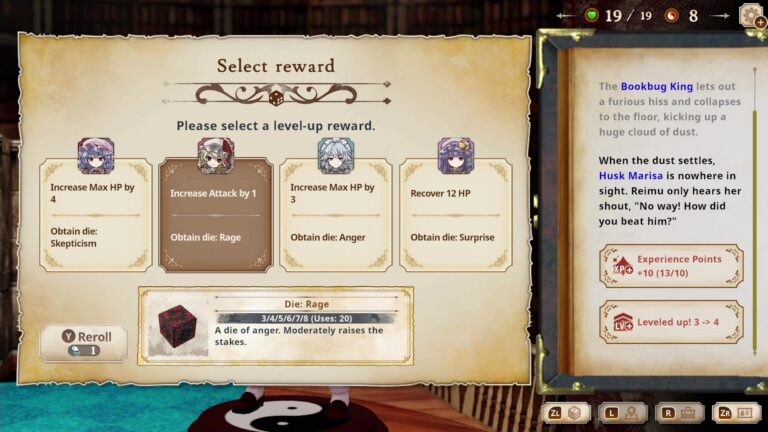
Sometimes, though, you might not agree with anyone’s viewpoint. You might only have 1 HP left, and nobody suggests recovering HP, for example.
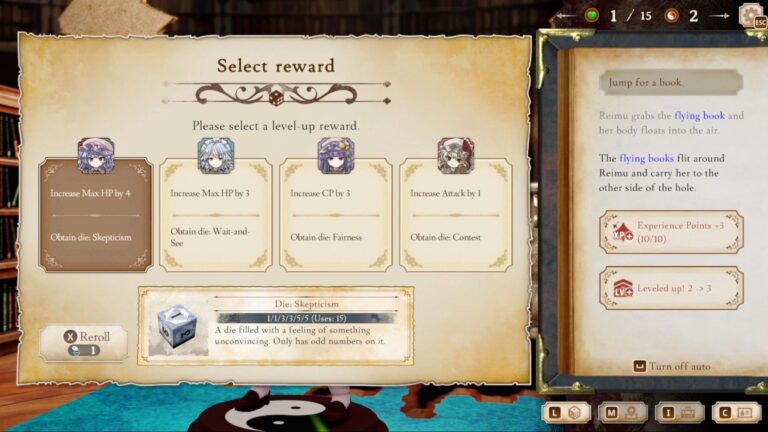
In cases like that, you can use 1 CP to “reroll” their viewpoints. It costs the same amount as rerolling your dice, so if you happen to have extra CP lying around, you can use them until you get a viewpoint you want.
What Should I Choose?
Adaptability is important for any adventurer—that means picking options based on your current situation. But if you choose wrong, you might just be temporarily patching yourself up every time. If you want a smoother adventure, I’d recommend deciding on how you want to play the game right from the start, then choose level-up options that play into that.
There are three ways you can improve Reimu.
1.Focusing on Attack
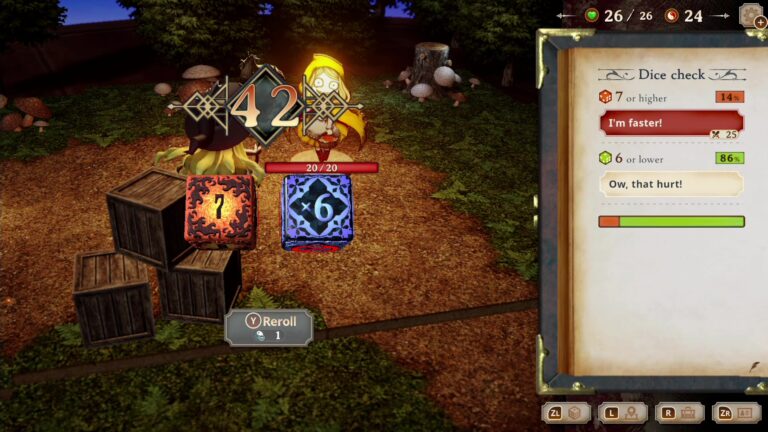
This will increase your attack power. It’s a staple in every RPG and can lead to a lot of epic adventures.
By increasing your Attack, you’ll deal more damage to enemies in combat. That will let you defeat them more quickly, which means you’ll also take less damage—because they’ll have less chances to attack you back. It can be quite exhilarating to focus on Attack.
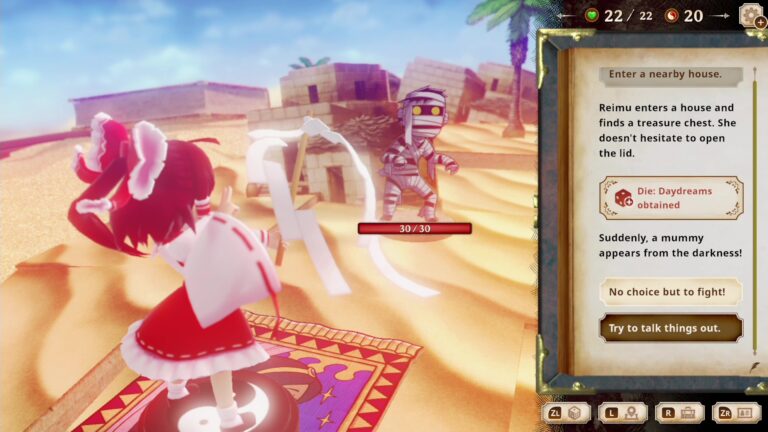
The weakness of this approach is that Attack will only ever help you in combat. Marisa of Liartop Mountain isn’t just about fighting bad guys. Many trials await you—you’ll need to search for things or people, stay hidden in the shadows, and negotiate your way through situations, and those are just a few examples. You’ll want to make sure you don’t get tripped up by anything you can’t solve by fighting.
2.Focusing on CP
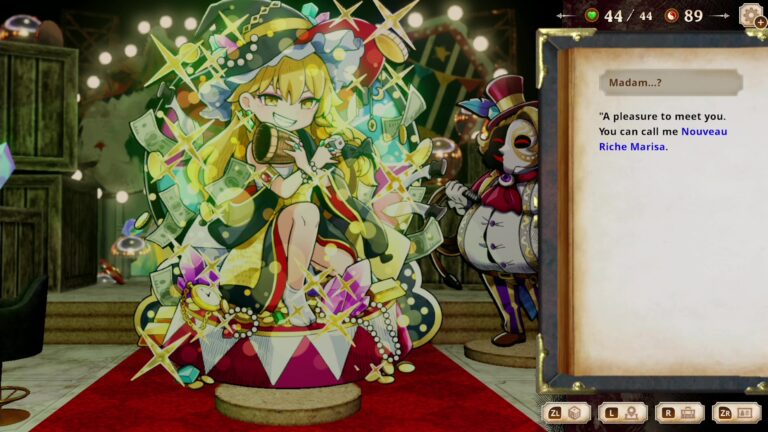
This is a somewhat tricky playstyle where you build up lots of CP to use on rerolling dice and such.
Having extra CP means you can dodge attacks that you normally wouldn’t be able to and make your own attacks hit when they normally wouldn’t. Your goal is to force crazy dice rolls. You can also use the CP when you level up to get dice that will help you in the current situation.
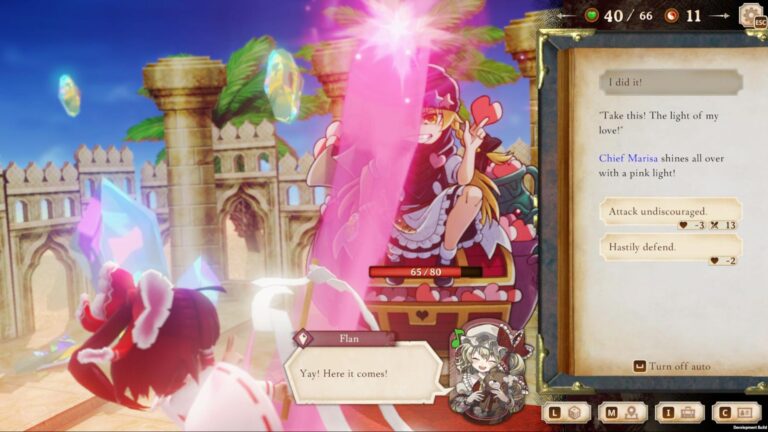
On the other hand, the weakness of this approach comes into play whenever you have to take damage no matter what, and you’re not allowed to roll dice for it at all. And if you go too light on your Attack, you might end up using way more CP than you meant to.
3.Focusing on HP
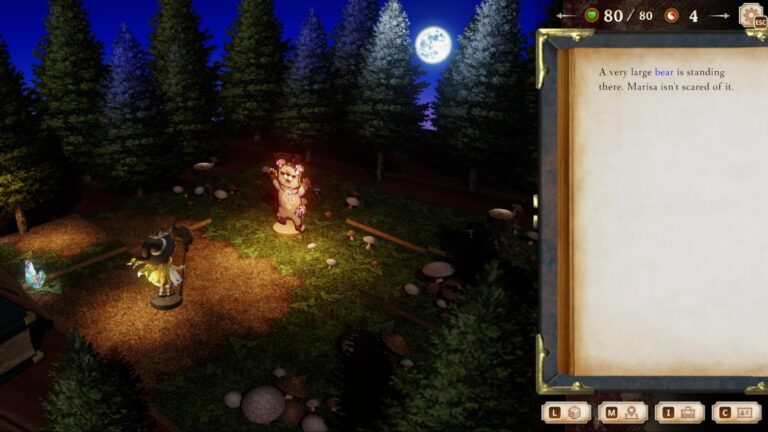
Marisa of Liartop Mountain is an RPG. That means that as long as you have 1 HP left, you haven’t lost. Therefore, if you get more HP, you should be able to win before you lose. This is a fun idea in its own right.
Just between you and me, there aren’t a whole lot of places in this game where you can recover HP. You don’t get all your HP back when you level up, either—though you do when you clear a chapter. Still, the ability to shrug off minor damage is very powerful.
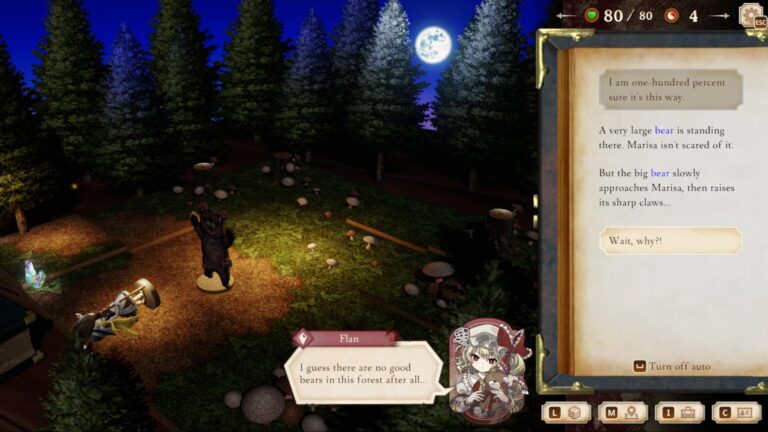
Nevertheless, if you focus too much on HP, you might end up really hurrying against enemies that you need to defeat in a specific amount of time. And if an insta-death trap springs and your adventure abruptly ends, it won’t matter how much HP you have. You might almost never die, but that “almost” is the biggest weakness of this approach.
Guide to the Early Steps of Your Adventure
Marisa of Liartop Mountain has five chapters in all. You don’t seem to be the sort of adventurer who needs hand-holding for all of them, but you might still make a mistake in the early part of the game. Just to be safe, here’s a rough guide for the first three chapters.
・ Chapter 1: The Library
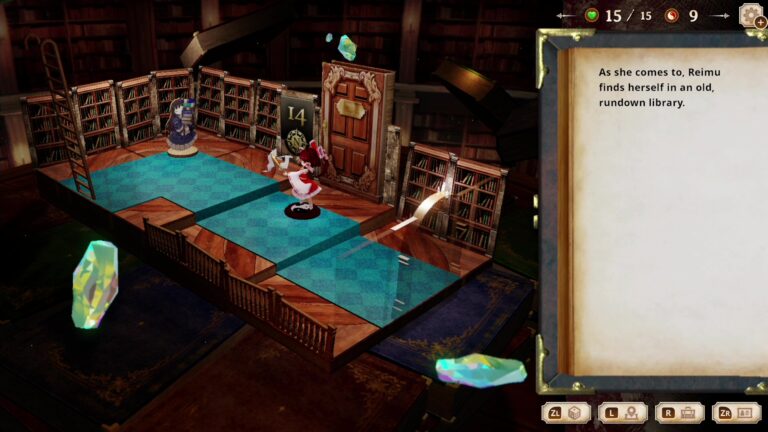
This place is all connected by hallways that spiral up and down, so it’s easy to get lost in. For the beginning, you may want to keep your map open while exploring to get a better understanding of how the rooms are linked together.
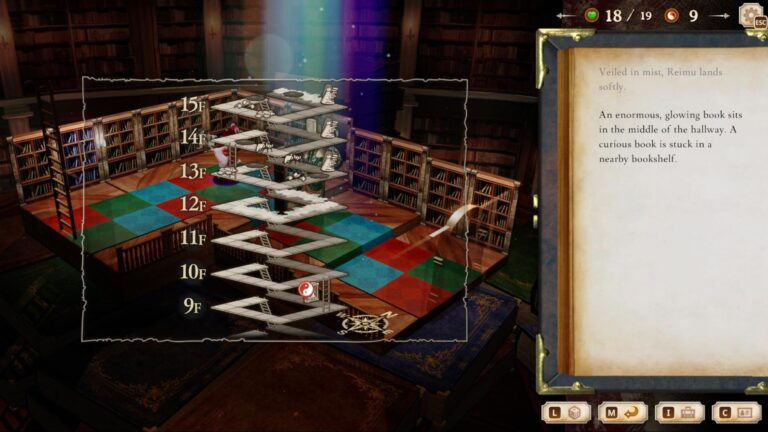
Many of the dice rolls here will give better results the higher you roll, so gathering dice with high numbers of their faces will help you progress efficiently. Still, you can’t do everything with high rolls, so you should take other dice with so-so faces for the added security. “I didn’t expect something like that to happen!” is the kind of complaint that no first-rate adventurer utters.
・ Chapter 2: The Desert

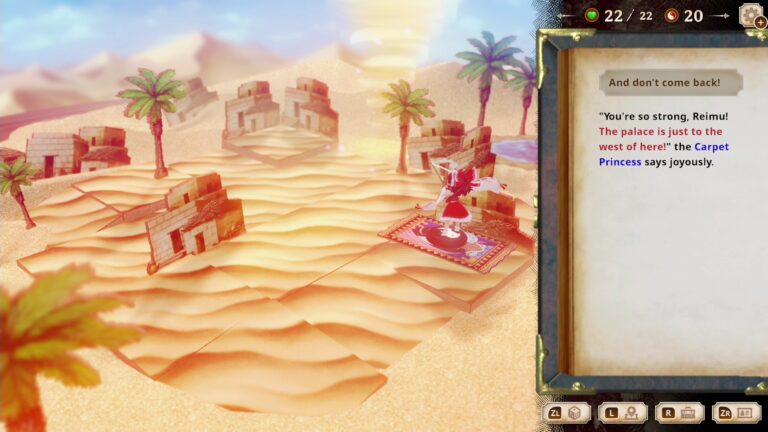
Chapter 2 takes place in a desert where sections are walled-off due to sandstorms. What’s neat about this chapter is that the explorable area will get bigger the further into the adventure you get. You’ll also run into a lot more enemies than Chapter 1, so maybe you’ll want to try avoiding taking damage to begin with instead of defeating them outright.
Chapter 2 has many instances where you’ll want lower numbers on the dice, so you may want to find some dice with lower-ranking faces. Still, battles are frequent, which means so are dice rolls—you’ll want to grab that maximum die capacity upgrade from leveling up.
・Chapter 3: The Forest
This chapter features a forest at night. You might be surprised at what happens at the very beginning of this chapter. I’d suggest playing it for yourself to find out.
On the whole, there are many places where you’ll get better results from rolling close to a total of 7 on your dice—and not only that, there are enemies that will debuff you in combat, for example by setting a specific number on all your dice to 0. There are some dice that can cancel out these debuffs, so taking some in with you will give you an advantage.
Aside from boss enemies, every chapter has a powerful enemy as well. When you come face to face with such enemies, there may be ways to get past them that don’t involve fighting. And if you don’t have to fight, the wise choice is usually not to force it.
Before You Curse Your Bad Luck…
Marisa of Liartop Mountain is a game based around rolling dice, but luck isn’t the be-all end-all. If you choose dice effective for the situation and master using CP to reroll them, your luck will actually become less important.
On the other hand, if you keep running into situations that make you think it is all dependent on luck and nothing else, then you may—possibly—be making some kind of miscalculation.
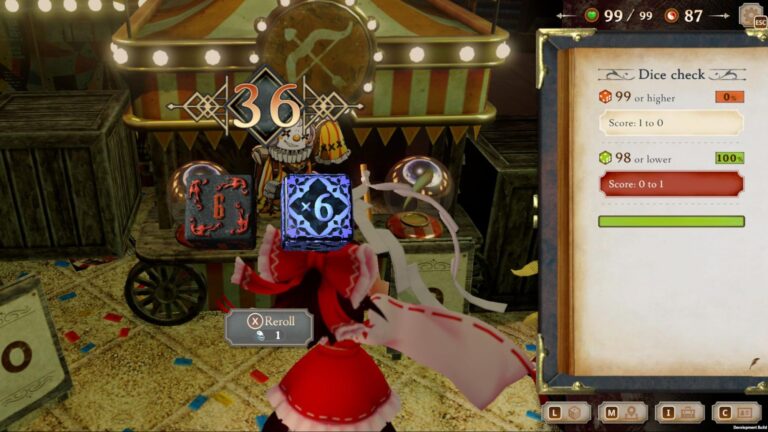
While Marisa of Liartop Mountain is an RPG, it includes some mystery-solving elements. You’ll also need to pay attention to how enemies behave in order to take advantage of their weaknesses. If you calmly read the text and keep your ears open to what you hear, you’re sure to find a path to victory.
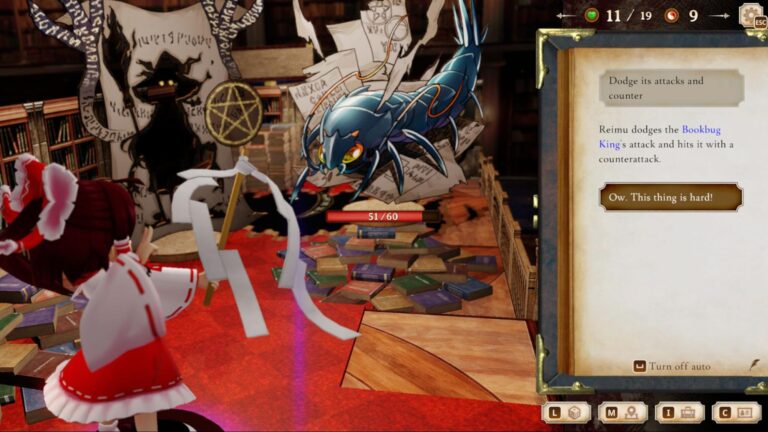
And there’s usually more than one path to victory, too. You might be able to crush an enemy with incredible luck on your dice rolls, but you might also be able to win without rolling at all. You might even find some surprising hidden options.
…All that said, you might come to a point when you feel like you’re truly all out of options. Like you’ve been fully defeated. When that happens, you can always go to the menu and choose “Restart from Chapter Start.”
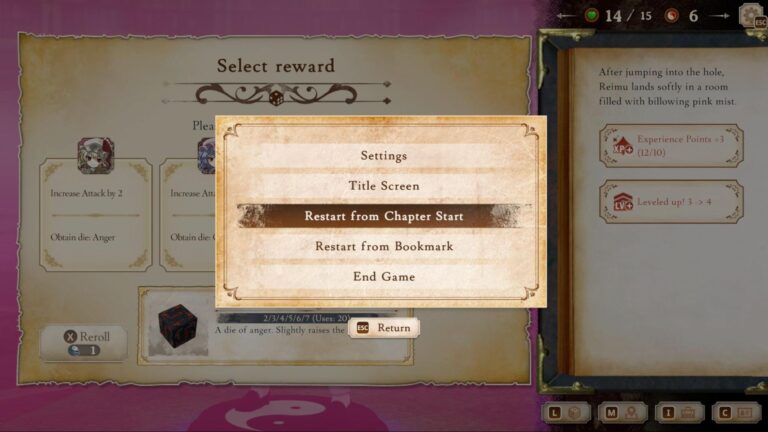
Luck is far from the most important thing an adventurer can have. Nor is it knowledge, skill, or strength. The most important thing is never to give up.
You may perish on your first adventure through this mysterious world. But as long as you don’t give up, you’re sure to reach that great goal waiting for you at the end of the journey.
Author: Marisa of Chapter 9998